
Credit iStock/FrankRamspott
Credit iStock/FrankRamspott

Credit iStock/FrankRamspott
Credit iStock/FrankRamspott
In traditional economic policy analysis, monetary policy, financial policy, and fiscal management are often viewed as separate domains. Yet they converge on a single operational plane: the economy’s liquidity.
Monetary policy, payment system management, and Treasury financial programming operate in a common market, directly shaping financial sector liquidity and conditions in the interbank market—and, for treasuries, the timely execution of government payments. Within this framework, fiscal flows have an immediate bearing on the operational implementation of monetary policy.
The Role of the Central Bank (CB)
The CB plays a critical role through closely linked functions. It promotes macroeconomic stability by strengthening resilience to liquidity shocks and ensures the efficient functioning of the payment system. Because liquidity conditions are shaped by Treasury operations, the financial sector, and other economic agents —and because government cash flows are typically among the largest and most concentrated in the money market— the CB must account for these interactions to manage liquidity consistent with its macroeconomic objectives.
From an operational perspective, monetary policy relies on a policy signal, typically expressed through the monetary policy rate (MPR), and on active liquidity management operations that influence bank reserves and systemic liquidity.
A close alignment between the MPR and the interbank rate is a necessary first step for effective monetary policy transmission. When this alignment holds, the policy signal anchors short-term interest rates more effectively. Experiences in countries such as the Dominican Republic and Costa Rica illustrate how liquidity conditions and policy actions can influence this relationship over time.
Figure 1. Monetary Policy Corridor for the Dominican Republic

Note: Author’s calculations based on data from the CB.
Figure 2. Monetary Policy Corridor for Costa Rica
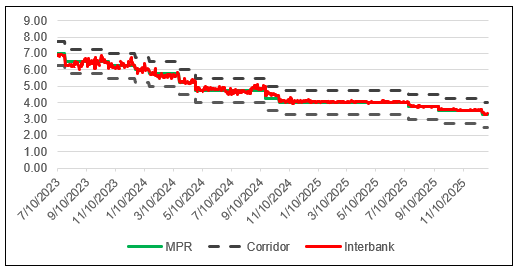
Note: Author’s calculations based on data from the CB.
It is useful to distinguish between transmission from the MPR to the interbank rate and transmission to longer-term retail interest rates. The former is typically faster when interbank markets function well, and liquidity is adequately managed. When this link weakens, the monetary signal can lose strength, and distortions may arise in financial markets. Treasury Financial Programming and Liquidity Treasury financial programming consists of the integrated planning of government revenues, expenditures, and financing needs, organized around the management of the Treasury Single Account (TSA) and focused on short-term horizons. Its central objective is to ensure the government can meet its payment obligations at the lowest possible risk and cost, while avoiding unnecessary volatility in the financial system. Because Treasury operations can be large relative to the economy the CB should be able to anticipate movements at the TSA through efficient communications with Treasury, allowing it to calibrate sterilization or injection in a manner consistent with its inflation and output objectives. Coordination Between Treasuries and CB Operational coordination and information sharing between monetary and fiscal authorities are essential components of macroeconomic stability. A broad and well-managed TSA located at the CB enables the consolidation of public resources and provides a comprehensive view of potential liquidity effects of government operations. Regular information exchange on cash projections, payment calendars, and issuance schedules, strengthens the CB’s capacity to anticipate the impact of fiscal flows on the money market. From a public financial management perspective, the core benefit for the Treasury of holding its liquidity at the CB is narrowly defined but fundamental: the elimination of custody risk over government cash balances. A TSA at the CB transforms government liquidity into a claim on the issuer of the national currency, removing credit and systemic liquidity risks associated with private or other public custodians. This feature cannot be replicated through improved cash forecasting, operational reforms, or diversification across financial institutions. In this context, concentration does not increase risk; it effectively shrinks it, by placing government cash outside the domain of solvency and liquidity concerns that apply to commercial counterparties. Importantly, the location of the TSA at the CB does not substitute for sound cash management practices, nor does it necessarily relax fiscal or liquidity constraints. All other risks—forecasting errors, payment bunching, weak commitment controls, or inadequate financial planning—remain the responsibility of the Treasury. Operational coordination with the CB does not provide additional financing or liquidity support; it ensures that the Treasury’s cash balances are held in an institution that is not itself a source of risk. Within clear institutional safeguards and prohibitions on monetary financing, such an arrangement allows both institutions to operate within hard budget constraints while preserving the integrity of public cash holdings. When fiscal and monetary authorities act in concert, liquidity management becomes more efficient and overall policy effectiveness is enhanced. This article draws on discussions held during a CAPTAC-DR seminar that brought together Treasury officials from Central America, Panama, and the Dominican Republic to exchange regional experience on cash and liquidity management. Read here an in-depth article on this topic.


